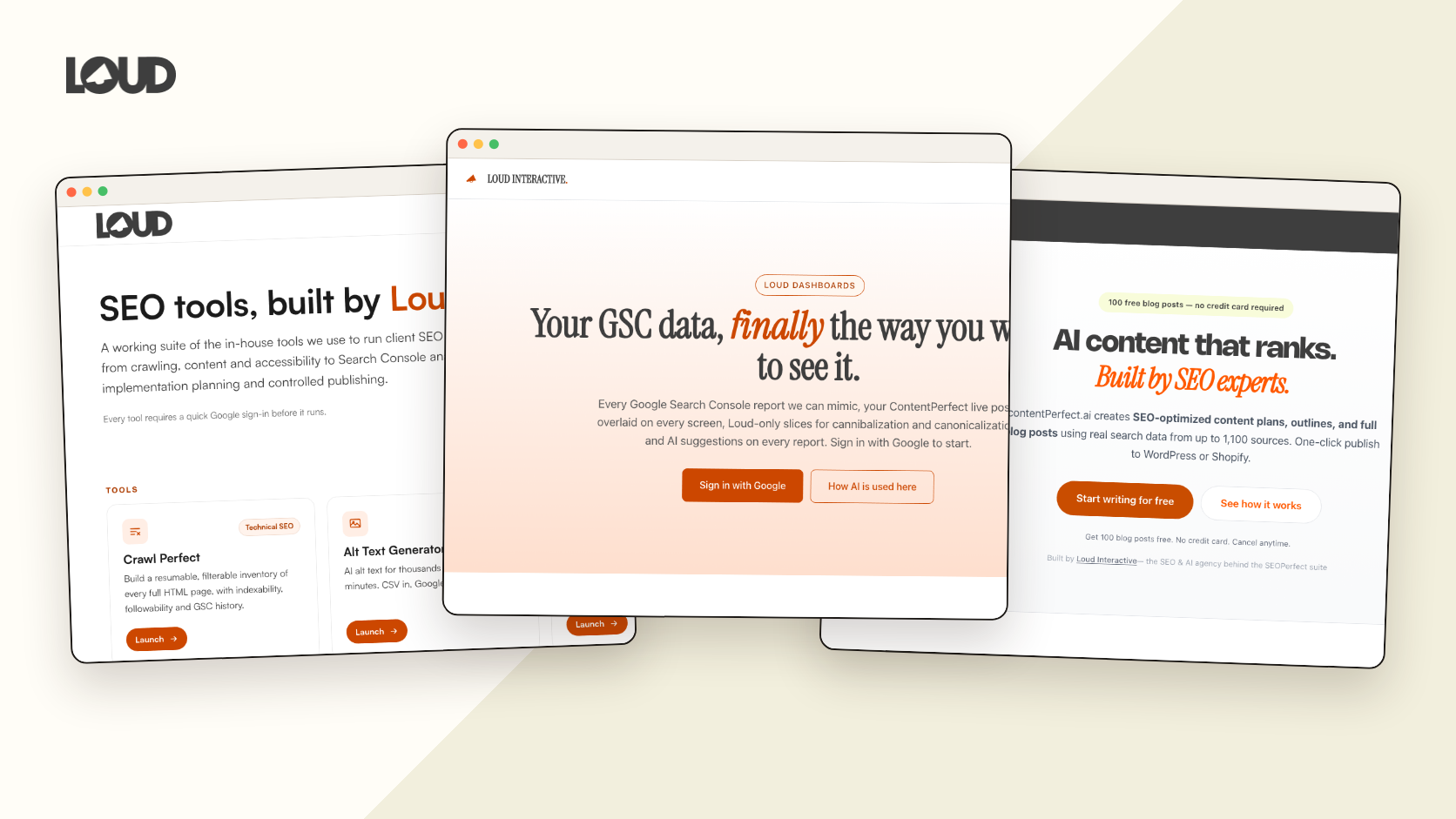

SEO teams do not suffer from a shortage of dashboards. They suffer from the gap between discovering a problem and shipping a reliable fix.
That gap is why we built seotools.loud.us. It is a growing collection of focused SEO applications developed from real delivery work at Loud Interactive. Some tools compress a task that used to take hours into minutes. Others make a complicated process safer by preserving source data, creating reviewable outputs and recording what happened.
The public suite is not a collection of generic AI wrappers. Search Console data, live-page retrieval, structured outputs, resumable jobs and quality controls appear throughout the platform. AI is used where it improves interpretation or production, while deterministic checks handle tasks such as URL validation, schema formatting, crawl management and output preservation.
CrawlPerfect: adaptive website crawling
CrawlPerfect is our high-speed website crawler. It discovers URLs from robots.txt, nested XML sitemaps and internal links, normalizes duplicates and strips tracking parameters before they enter the crawl frontier.
The important distinction is adaptive control. A fixed crawl rate is either slower than necessary or too aggressive for some origins. CrawlPerfect samples response latency, timeouts, rate limits, server errors and local pipeline pressure, then adjusts toward the fastest stable operating point. Slow URLs can be deferred and recovered in later passes instead of holding the entire crawl hostage.
The result is a more practical technical inventory for large sites: broad discovery, controlled pressure on the origin and a clearer accounting of pages that require another attempt.
The best SEO tool does not stop at finding a problem. It creates the evidence and output needed to finish the work.
Alt Text Generator: accessibility work at catalog scale
The Alt Text Generator turns a CSV of image records into a Google Sheet of proposed descriptions. It is intended for the awkward middle ground where a site has too many images for one-at-a-time editing, but accessibility still requires descriptions that reflect the actual visual content and context.
The tool produces editable output rather than forcing changes directly onto a website. That matters because good alternative text is contextual. A useful description for a product image, editorial illustration or decorative asset is not the same thing. The reviewable Sheet lets a team approve, revise or exclude recommendations before implementation.
FAQPerfect: grounded answers and valid FAQ schema
FAQPerfect generates page-specific FAQs and matching FAQPage structured data. It accepts individual URLs, a CSV or a Google Sheet, making it useful for a single important landing page or a larger page set.
FAQ generation is easy to do badly. Questions can become generic, answers can introduce unsupported claims and schema can drift away from the visible copy. FAQPerfect starts with the source page, creates questions grounded in that material and keeps the human-readable answers aligned with the JSON-LD output. The goal is useful customer content first, with structured data that accurately represents it.
Three ways to resolve keyword cannibalization
Keyword cannibalization is not simply “two pages rank for the same phrase.” The actual work is deciding whether pages serve different intents, whether one should be consolidated, and which implementation—internal linking, content differentiation, canonicalization or redirecting—best preserves value.
We built three workflows because the available data and the shape of the site vary:
- Single-Domain De-Cannibalization uses Google Search Console data to identify competing URLs and produce a consolidation plan for one site.
- Multi-Domain De-Cannibalization analyzes overlap across a network of sites, where the correct answer may involve cross-domain canonicals, redirects or a deliberate division of search intent.
- Flat-File De-Cannibalization accepts exported URL-and-query data when direct Search Console access is unavailable or inappropriate.
All three are built to move beyond detection. Their outputs are implementation-oriented, so an SEO or development team can review the evidence and act on a defined recommendation.
Direct Search Console connection, multiple domains or a flat file: use the workflow that fits the evidence you actually have.
Title & Attribute Generator: SEO and accessibility for links
The Title & Attribute Generator analyzes links and produces title-attribute recommendations informed by page context and Search Console data. It is especially useful when a large navigation system, directory or interface needs more descriptive link context without a manual link-by-link exercise.
Accessibility is not improved by stuffing redundant text into every attribute. Recommendations need to add meaning, remain concise and avoid restating an already clear anchor. The tool’s reviewable report makes those decisions visible before anyone changes production markup.
Sitemap Generator: discovery, hosting and daily refreshes
The Sitemap Generator builds and hosts XML sitemaps for a supplied domain. It can inventory URLs, segment sitemap files, surface discovery gaps and refresh the generated files daily.
This is useful when a CMS produces incomplete sitemap coverage, when important pages live across several systems, or when a team needs a controlled sitemap layer without rebuilding the publishing platform. The dashboard provides the files, implementation directions and a record of what changed.
Loud Dashboards: Search Console data made actionable
Loud Dashboards is the measurement and decision layer in Loud’s SEO platform. It reorganizes live Google Search Console data into practical domain dashboards for search performance, pages, queries, sitemaps, URL inspection, enhancements and Core Web Vitals. Google access is read-only and can be revoked through the connected Google account.
The application goes beyond reproducing standard Search Console reports. It overlays posts published through ContentPerfect so teams can measure impressions, clicks, rankings and query visibility for Loud-produced content alongside the rest of the site. It also adds Loud-specific views for keyword cannibalization, canonical mismatches, navigation URLs, branded-versus-generic performance, ranking movers and tracked keywords with daily snapshots.
Each report can produce AI-assisted recommendations using the report data and available brand context. This connects evidence to the next decision: where traffic is changing, which URL is competing, what content is beginning to perform and which technical or editorial action deserves attention. In that sense, ContentPerfect helps teams create and publish, while Loud Dashboards helps them measure, diagnose and prioritize what happens next.
ContentPerfect: Loud’s flagship content and SEO platform
ContentPerfect is the flagship platform behind Loud’s larger content operations. It connects search data, brand knowledge, editorial preferences and publishing integrations into one governed production system.
The workflow starts before writing. ContentPerfect can use Search Console and other discovery inputs to build content plans, organize topic opportunities and create structured outlines. Those outlines become full posts with metadata, internal links, imagery and structured data. Teams can review individual stages, regenerate the part that needs work, retain an audit trail and publish through an authorized CMS integration when the domain is configured for it.
That makes ContentPerfect different from a blank AI prompt. A prompt produces an answer for one moment. ContentPerfect maintains the domain context, preferences, production state and next action across a continuing program. It supports content planning, outline development, post generation, image workflows, schema, editorial review, scheduling, downloads and direct publishing for supported WordPress, Shopify and custom implementations.
ContentPerfect turns a collection of prompts into a governed content operation with state, review, preferences and publishing controls.
Why 265 preference fields make the tools better
Generic inputs produce generic outputs. ContentPerfect’s Preferences area currently exposes 265 configurable fields across company facts, brand identity, audience, restrictions, social channels, CMS settings, product catalog data, blog structure, calls to action, media guidance, integrations and AI prompts.
No organization needs to complete every field before doing useful work, and every tool reads only the subset relevant to its job. The improvement comes from replacing assumptions with verified context. Company facts strengthen entity consistency. Audience and positioning fields sharpen search intent. Voice, vocabulary and sample content reduce generic phrasing. Restrictions prevent disallowed claims and terminology. Product feeds improve page-level grounding. Approved links and CTA settings produce safer implementation-ready content. CMS and publishing preferences tell the system what it may do—and what it must not do.
Taking the time to complete and maintain the relevant preferences makes PagePerfect recommendations more brand-specific, FAQ answers more defensible, ContentPerfect posts more consistent, schema more accurate and custom publishing workflows safer. Preferences are not decorative profile data. They are the reusable operating instructions shared across Loud’s AI-assisted SEO work.
PagePerfect for Shopify: from catalog discovery to reviewable SEO
PagePerfect for Shopify is the domain-agnostic version of our Shopify page-optimization pipeline. It discovers active product and collection pages directly from Shopify, combines live-page content with available search data and brand preferences, then generates proposed titles, meta descriptions, headings, page copy and structured-data recommendations.
The workflow supports two deliberate paths. Teams can generate a Google Sheet for review, edit it without changing required headers and publish the approved file later. Authorized users can also choose a direct-publishing workflow when speed matters and the URL scope has already been approved.
URL restrictions are treated as a safety boundary. A scoped run may discover the broader catalog for context, but generation, output and publishing remain limited to the accepted product and collection URLs. Unsupported page types are skipped and reported instead of being silently processed.
Direct Shopify publishing requires more than a spreadsheet or an API token pasted into a form. Loud builds and configures a Shopify app with the appropriate OAuth flow, access scopes, privacy webhooks, installation records, change logging and rollback controls. That publishing integration is currently available only to Loud Interactive clients. Public visitors can understand the PagePerfect workflow, while production access is provisioned as part of a managed engagement.
Custom AI solutions for specific SEO challenges
The tools listed here are the public edge of a considerably larger custom-software practice. Loud engages with clients by identifying the expensive, repetitive or error-prone part of an SEO program, then designing the smallest dependable system that can solve it at the required scale.
A custom engagement may extend one of the public tools with a private data source, domain-specific preferences, approval rules, a product-information system, a digital asset manager, a CMS integration or a monitored publishing path. It may also produce a completely new application when the problem does not fit an existing workflow. The same engineering patterns behind crawling, de-cannibalization, structured content, accessibility, sitemaps and PagePerfect can be combined without exposing one client’s data or rules to another.
We also evaluate where AI should run. Cloud models remain valuable for complex generation and judgment, but not every classification, extraction, rewrite or quality-control pass needs the most expensive remote model. Loud is actively evaluating local inference on an Apple M5 system and, later, a dedicated compute cluster for high-volume steps that can meet the same quality and safety threshold locally. The goal is not “local AI” as a slogan. It is lower marginal cost, better data control and more predictable throughput without weakening the output.
The principles shared by every tool
Although the inputs and outputs differ, the tools follow a consistent set of product principles:
- Ground recommendations in evidence. Use live pages, Search Console data, supplied files and explicit preferences wherever the workflow allows.
- Create reviewable deliverables. A Google Sheet, HTML report, sitemap or structured export is easier to inspect and hand off than an opaque score.
- Preserve the source. Inputs remain intact when new recommendation fields are appended.
- Design for interruption. Long jobs use batching and checkpoints so a transient failure does not require starting over.
- Separate generation from publishing. Live changes are deliberate actions, with scoped inputs and review paths where appropriate.
- Keep client data private. Loud does not sell email addresses, client data or mailing lists. Each tool has a specific privacy policy and terms page describing the services and data involved.
Who should use SEO Tools by Loud Interactive?
The suite is useful for in-house SEO teams, agencies, developers, content strategists and accessibility practitioners who already understand the problem they are solving and want a faster route to a quality-controlled deliverable.
Some tools can be explored immediately; others require Google sign-in or authorization because they work with Search Console, Google Sheets or publishing integrations. Access controls are part of the product, not friction added as an afterthought.
We will continue adding tools when a repeated SEO problem deserves a durable workflow. The standard is simple: the application should help a team finish the work, not merely produce one more place to look at it.
Key takeaways
- SEO Tools by Loud Interactive is a collection of focused production tools, not a single all-purpose dashboard.
- ContentPerfect is Loud’s flagship system for planning, generating, reviewing and publishing ongoing content programs.
- The 265 available preference fields give each workflow verified brand, audience, product, editorial and implementation context.
- Direct PagePerfect publishing requires a properly configured Shopify app and is currently available only to Loud clients.
- Loud builds private, custom AI and software solutions when a client’s SEO challenge extends beyond the public tools.
Explore SEO Tools by Loud Interactive or talk with our team about a custom solution for your SEO workflow.